There was a time when business leaders believed they could run entire organizations relying on intuition, expert opinions, and personal networks. A good memory, a stack of reports, and perhaps a reliable assistant were enough to keep processes moving. Then came spreadsheets, databases, and dashboards, which were useful at first, until they piled up and turned clarity into clutter.
And then AI appeared on the horizon: shiny, powerful, promising to predict the future. AI is firmly on the board agenda, yet most delays have little to do with algorithms and everything to do with data. Many initiatives never make it to production, and those that do often fail to deliver value. Multiple industry studies place the shortfall between 70 and 85 percent. The causes vary, but the pattern is familiar: fragmented systems, poor data quality, and weak ownership.
You cannot automate disorder. If the inputs are inconsistent, the outputs will be unreliable. If the data cannot be governed, the risks will outweigh the rewards. The path to AI at scale begins with steady, visible improvements in data maturity.
What “data chaos” looks like
Data chaos doesn’t look dramatic at first. It sounds like a violin slightly out of tune in an orchestra. One file has missing fields. Another system uses a different calendar. A third team keeps its own version in Excel because “the official tool is too slow.”
Over time, these small flaws seep into the cadence of daily work, where decisions take longer, reports contradict each other, and teams build side tools just to keep moving. Finance hears one truth, marketing hears another, operations a third.
Let’s say, metaphorically, AI is asked to conduct the orchestra, but when every instrument plays from a different score, no harmony is possible.
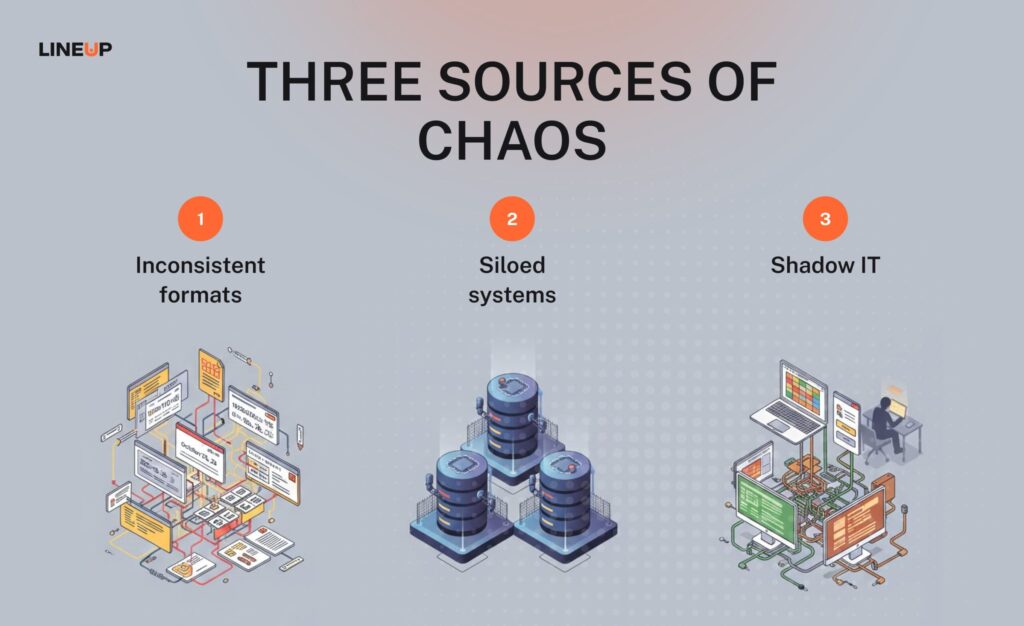
Inconsistent formats. Names, dates, product codes, and reference fields are recorded in different ways across business units. A report looks complete, yet two teams reach different conclusions because the underlying fields do not match.
Siloed systems. Finance, sales, marketing, and operations store similar facts in different places. Without a shared layer to reconcile them, there is no trustworthy view of customers, inventory, or risk.
Shadow IT. Teams spin up spreadsheets, SaaS trials, or custom apps outside IT. The parallel stack grows quickly, creating duplicate licenses, security exposure, and spend that is hard to control. Gartner has estimated that 30–40% of enterprise IT spend occurs outside official channels.
None of these are fatal on their own. Left untreated, these issues do more than frustrate staff. They block trustworthy AI, and they undermine confidence in the results when models finally ship. Public-sector reviews echo the same theme: poor data quality and legacy systems sit near the top of barriers to using AI effectively.
The AI-readiness checklist
Getting ready for AI is less about magic and more about housekeeping. You do not need perfect data to start, but you do need structure. The following checklist is a pragmatic baseline for CTOs and CIOs, it is nothing but a way to turn scattered information into something usable.
Think of it as clearing your desk before bringing home a shiny new laptop. The device may be powerful, but without space to work, it won’t help you much.
- Data collection. Make sure you’re capturing all the streams that matter: transactions, customer interactions, operations, IoT. If it’s important to the business, it should be in the system.
- Data cleansing. Remove duplicates, fix broken fields, and standardize formats. Do this continuously, not once a year. CDO surveys through 2024–2025 repeatedly cite data quality as a primary barrier to AI adoption, which is why this step deserves dedicated owners and SLAs.
- Data integration. Pull everything into a unified view — whether that’s a data warehouse, a lake, or a hybrid approach. The goal is a trusted, consistent view of core entities so models do not learn from conflicting truths. Industry guidance in 2025 increasingly frames this as moving toward domain “sources of truth” governed by common contracts, not a single monolith.
- Data governance. Decide who owns the data, who gets to touch it, and how long you keep it. Regulations like GDPR or HIPAA aren’t optional. All in all, this is how you make data reusable without re-negotiating risk each time.
- Trust and security. Map data flows for every AI use case, including tools adopted without approval. Close gaps where prompts or outputs may expose sensitive information, and document controls before you scale. Security teams and engineering should work from one plan.
Crawl, walk, run: a practical maturity path
Big-bang rewrites are tempting, yet they rarely survive first contact with reality. A phased approach builds momentum without putting the enterprise at risk.
Crawl: fix the basics
Standardize key fields, assign data owners, and publish definitions that teams can find. Start quality rules where they pay back quickly: customer master, product catalog, locations, and identifiers. It’s the data equivalent of brushing your teeth.
Walk: build the pipelines
Move from manual extracts to scheduled jobs and event-driven feeds. Introduce contracts for data products so consuming teams know what to expect, and so changes are negotiated, not discovered in production. If you are moving to cloud, do it with a thin slice of real use cases so benefits are visible.
Run: enable models and agents
Once the plumbing is stable, introduce predictive models, copilots, or AI agents in workflows people already use. At this stage, predictive analytics or virtual assistants actually deliver results because the underlying data won’t trip them up.
How to measure readiness without boiling the ocean
Use a short scorecard that fits on one page. Re-score quarterly.
- Coverage: the share of priority data domains with named owners and documented schemas.
- Quality: defect rates on critical fields, and time to resolve issues.
- Timeliness: percentage of data available within the service window the business needs.
- Accessibility: number of approved consumers, plus average time to grant access.
- Governance: audit completeness, privacy controls, and lineage depth for regulated data.
Keep thresholds realistic. The aim is steady lift, not a gold star.
A story from the field
A regional bank once set out to launch an AI assistant for cross-selling. The idea looked simple: recommend the right product to the right customer at the right time.
Except there was one problem. Customers didn’t look the same in every system. In the credit card database, Jane Doe was Jane A. Doe. In the loan database, she was Jane Doe-Smith. In CRM, she was J. Doe. To the bank’s AI, these were three different people — and the recommendations made no sense.
So the bank stepped back. First, they cleaned and standardized the data. Then, they built pipelines to unify it daily. Only after that did they let the AI assistant back into the workflow. This time, the results were clear: faster service, more relevant offers, and real revenue growth.
The bank didn’t need a better algorithm. It needed better data.
Common objections, clear responses
“Our data is a mess, we are not ready.”
Start small. Pick two domains, standardize them, and wire up one pipeline for a real use case. Prove the lift in weeks, then add scope. Analyses in 2024–2025 show that most organizations struggle to achieve and scale value, not to prototype. Momentum matters more than perfection.
“We do not have the people.”
Name owners for the domains that matter and free time for them by stopping low-value reports. Upskill a small data reliability crew that pairs with engineering. You will move faster than hiring a large team you cannot support.
“Shadow IT is how we get things done.”
Acknowledge the reality, then bring it into daylight. Catalog the tools, put guardrails around sensitive data, and retire duplicates as the governed path improves. The financial and security risks of unmanaged tools are well documented.
Closing thought
AI is not a shortcut around weak data. If your inputs are inconsistent, your outputs will be inconsistent. If no one owns the data, no one owns the results. The good news is that readiness is not abstract. Choose a narrow scope, raise the standard each quarter, and prove value in business terms. The transformation starts with discipline, and it compounds.